
Expertise law is the area of legal practice where specialized knowledge, from scientists, engineers, ecologists and other qualified professionals, is presented to a court and tested through evidence. In environmental litigation, it decides whether a judge can fully understand what is at stake: how a development affects a watershed, how contamination moves through soil, or how a loss of tree canopy changes a neighbourhood.
Expert evidence on its own isn’t enough. A skilled litigation team knows how to choose the right experts, frame their findings in plain terms, and withstand cross-examination so the court hears the science clearly. That experience is often what turns sound research into persuasive testimony, and it’s the work behind the legal victories that safeguard green spaces and public health across Canada.
The same principle applies to the laws and agencies designed to protect your community. Strong rules matter, but they only work when people with the right knowledge and courtroom skill stand behind them.
This article explains how expert evidence and legal expertise work together, why litigation experience shapes outcomes, and how supporters make this work possible. Every donor, volunteer and community leader helps put credible science and capable advocacy in front of the courts. Read on to see how, and where you can lend your support.
What ‘Expertise Law’ Means in Plain Language
When people hear “expertise law,” it can sound like a specialty reserved for lawyers. In fact, it describes something simple: the rules courts use to decide who counts as an expert and how their specialized knowledge can be used as evidence. Most witnesses can only tell a court what they personally saw or heard. An expert is different. An expert may explain what the evidence means, and that is exactly why courts handle expert evidence with care.
Think of it as the bridge between science and the law. A judge may be skilled at weighing arguments, but not at interpreting water samples or measuring how a forest’s health has changed. Expertise law lets that scientific understanding reach the courtroom in a form the court can trust and act on.
A few key terms come up again and again:
- Expert witness
- A person with specialized training or experience who is permitted to give opinions in court on matters beyond everyday knowledge, such as ecology, hydrology or forestry.
- Qualified expert
- An expert whose education, experience and skills have been accepted by the court as suitable for the specific questions in the case.
- Expert report
- A written document setting out the expert’s findings, methods and opinions, usually shared with the other side before any hearing.
- Admissibility
- Whether a court will allow a piece of evidence to be considered at all. Expert evidence generally has to be relevant, necessary and given by a properly qualified person.
- Cross-examination
- The questioning of a witness by the opposing side, designed to test how reliable and balanced the expert’s opinions really are.
Why does this matter for environmental disputes? Because these cases so often turn on science that is technical, contested and unfamiliar to most people. If an expert is not properly qualified, or their report cannot withstand scrutiny, the court may give their evidence little weight or set it aside entirely. That can leave a community’s real concerns unheard, even when they are well founded.
Understanding these basics helps community members see what their legal team is doing behind the scenes. It also shows why careful preparation, long before anyone steps into a courtroom, is so important.
Why Environmental Cases Depend on Expert Evidence

Environmental cases rarely turn on legal arguments alone. They turn on questions of science, and those questions are often complicated. Is the water in a nearby creek safe? Is a stand of old trees part of a healthy, connected ecosystem? How much forest has been lost, and what does that mean for the wildlife and neighbours who depend on it? Judges and tribunals are skilled at weighing law and evidence, but they are not trained hydrologists, ecologists or climate scientists. They need specialized input to decide fairly.
That is where expert evidence comes in. A qualified expert can explain what the data shows, how it was gathered, and why it matters to the decision in front of the court. Think of it as translation. Raw measurements and field observations become clear findings that a judge can weigh and act on. Without that bridge, even a very real harm to a community’s forest or waterway can be hard to prove.
Strong expert evidence doesn’t happen by accident, though. It is chosen with care and prepared well in advance. The expert’s opinion has to be grounded in sound methods, written in plain language, and tied directly to the legal questions being decided. Decision-makers also tend to expect that the science meets recognized standards. Bodies like an environmental protection agency set and monitor many of those standards, so understanding how regulators approach a problem often helps a legal team frame the science convincingly.
This is why communities benefit when their lawyers understand both the law and the science. A legal team that speaks both languages can ask experts the right questions, spot gaps early, and explain technical findings without talking down to anyone. It also means neighbours and community leaders can follow what is happening in their own case, rather than feeling shut out by technical detail.
For people who care deeply about a local forest, stream or green space, that clarity is empowering. Your observations matter, and the right expert evidence can help turn them into something a court can use.
How Litigation Experience Strengthens Expert Testimony
Picture a group of neighbours who have spent years watching a creek near their homes. They know it ran clear once. Now they want a court to take that seriously. What they need is more than passion. They need someone who knows how a courtroom actually weighs scientific evidence.
That is where litigation experience earns its keep. Lawyers who have spent decades in hearings learn how expert evidence lands with judges and tribunals, and where it tends to stumble. An expert may be brilliant in the field and still struggle to explain findings in plain terms or hold steady under pointed questions. Experienced counsel helps close that gap.
In general, expert evidence in an environmental case moves through a sequence like this:
- Pinpoint the scientific question the court must answer, such as whether a development could change water quality or harm a wooded habitat.
- Match that question to an expert whose training and practical experience genuinely fit it.
- Share the community’s local observations and records with the expert so the analysis reflects real conditions on the ground.
- Prepare the expert’s written report to be clear, well supported and limited to what the evidence can honestly show.
- Rehearse cross-examination so the expert is comfortable explaining limits and uncertainties without being rattled.
- Present the findings in the hearing in plain language, tying the science back to the legal issues the court must decide.
Each step matters, and experience shapes every one of them. Knowing which expert fits which question saves time and strengthens credibility. Knowing how cross-examination tends to unfold means an expert can answer calmly rather than defensively. Presenting findings in everyday language helps a decision-maker follow the reasoning instead of getting lost in technical detail.
For the neighbours around that creek, this preparation means their concerns reach the court in a form it can use. Their observations become part of a careful, credible record. Canadian Parks & Trees Protection has spent more than 30 years helping communities do exactly this, and that long practice informs how every expert is chosen and prepared. Results in any case depend on the facts and the evidence, but thorough preparation gives a community’s voice its best chance of being heard.
Lessons From Three Decades of Standing Up for Communities
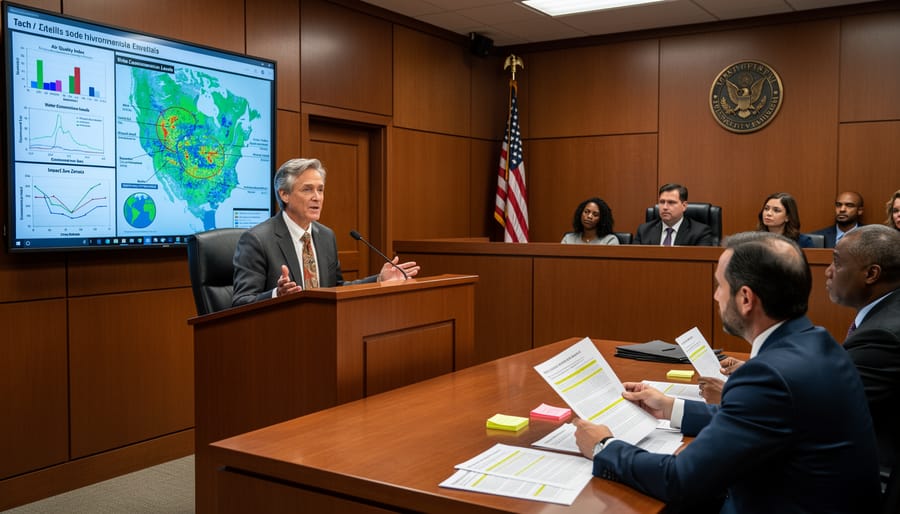
For more than 30 years, Canadian Parks & Trees Protection has stood beside communities that refuse to watch their forests, streams and green spaces disappear without a fight. That long record has made the organization one of the largest environmental legal advocacy groups in the country, and it has taught some lasting lessons about what protects nature in court.
The first lesson is that persistence matters. Environmental disputes rarely end quickly. Expert evidence has to be gathered, tested and explained, and hearings can stretch across months or years. Communities that stay organized and keep showing up give their legal team the time and the credibility to do the work properly.
The second lesson is that experience shapes judgment. After three decades in and around the courtroom, a legal team learns which questions an expert should be asked, how scientific findings land with a judge, and where a case is most likely to be won or weakened. That judgment is hard to build any other way, and it is exactly what expertise law rewards: evidence that is relevant, well explained and presented by qualified people.
The third lesson is that every victory belongs to a community. Legal wins are never only about a ruling. They are about neighbours who documented what they saw, residents who spoke up at meetings, and supporters who made the work possible. Each success, large or small, protects something real for the people who live nearby and for the wildlife that depends on it.
Many of those supporters are donors, and their generosity funds this work entirely. Their steady commitment is a big part of why the organization can keep standing up for nature, year after year, wherever a community asks for help.
What Communities and Supporters Can Do Next
Every community can take meaningful steps long before a case reaches a courtroom. Many residents learn to use environmental law most effectively by starting small and staying organized:
- Record what you see, with dates, photos and notes about local water, trees and wildlife.
- Keep a shared folder so neighbours can add observations in one place.
- Reach out for legal advice early, before decisions are final.
- Be patient, since expert evidence often takes time to develop.
Careful records give experts something solid to build on, and early conversations leave more options open. Local observations like these are the foundation of real-world conservation.
It’s also worth being honest: no one can guarantee how a legal matter will turn out. But informed, organized action gives your community a stronger voice, and that voice matters.
Expertise law matters because it decides how science reaches a judge, and experience is what makes that science count. When a legal team understands both the rules for expert evidence and the realities of the courtroom, a community’s concerns can be heard clearly and credibly. That is how nature gets a voice in court.
None of this happens without you. Our donors fund this work entirely, and we are deeply grateful for your generosity and your belief in protecting the places we all share.
If you care about a forest, a waterway or your neighbourhood, please support our work, share your story with us, or get involved today. Together, we can keep standing up for the places that matter most.